Bengaluru (Karnataka) [India], June 27: Three years into National Education Policy 2020, a Mysuru-based company is turning gazette notifications into working skill labs — in government schools, private schools across fifteen states, one skill session at a time.
When India’s National Education Policy 2020 was announced, it carried an ambition the country’s school system had long deferred. Not just better exam results or higher enrolment — something harder to measure and harder to build: a generation of students who could think, adapt, create, and find their footing in a working world that textbooks and syllabi alone were never going to prepare them for.
Now, with the National Curriculum Framework 2023 sharpening these directives further, the honest question is: what has actually changed inside Indian classrooms? The answer ranges from encouraging to uneven. But in pockets of the country — in a government school in Marikal, Telangana, and a private school in Moga, Punjab — students are building circuits, drafting business plans, and sitting aptitude assessments. The shift, where it is happening, is not subtle.
The Gap Between Policy and Practice
NEP 2020 was explicit about what it wanted: skill-based learning over rote memorisation, hands-on experiential teaching over passive instruction, and vocational exposure starting as early as Grades 6–8, where students spend ten days in bagless internships learning from local carpenters, gardeners, artists, and craftspeople. Career awareness, the policy insisted, should build gradually through school, not arrive as a surprise at board examinations. The NCF 2023 translated these ambitions into workable curriculum guidelines. PM SHRI schools — over 14,500 institutions targeted under the scheme, with more than 10,800 already selected across phases as of 2024 — were then given specific mandates to model this vision: innovative teaching methods, bagless days, artisan internships, vocational training, and early exposure to entrepreneurship.
What the policy left open was the harder question of execution. Building a lab inside a government school, writing curriculum that teachers can actually use, training those teachers, and then returning month after month to make sure the quality holds — none of that is in the gazette notification. It requires a different kind of organisation entirely.
What a Skill Lab Actually Does
At Sacred Heart School in Moga, Punjab, a student in Class 7 is not reading about circuits — she is building one. At DAV School in Chhattisgarh, a student in Class 9 is not learning what entrepreneurship means from a textbook definition. He is working through a module that takes him from identifying a community problem to sketching out a basic business model for solving it.
These are not extracurricular activities. They happen during the regular school timetable, in structured sessions, assessed and tracked through a platform that reports outcomes to teachers, parents, and administrators in real time. This is what NEP-aligned skill infrastructure looks like when it is working.
Kidvento Education and Research Pvt. Ltd., founded in Mysuru in 2017, has built one of India’s more substantial on-ground implementations of this infrastructure. The company has also set up over 500 government-sanctioned innovation labs across India — under three distinct Central and State Government frameworks: more than 250 Atal Tinkering Labs under NITI Aayog’s ATL programme, over 100 Srishti and Avishkar innovation labs in PM SHRI schools under Samagra Shiksha, and more than 100 innovation labs under the Department of Science and Technology, Government of Karnataka.
The distinction matters. These are not facilities Kidvento built and offered to schools independently. They are government programmes, mandated by policy, implemented in government and government-aided schools, with Kidvento as the on-ground execution partner.
Curriculum Is the Harder Problem
A lab, by itself, is infrastructure — a room with equipment and, on the best days, a teacher who knows what to do with it. What separates an innovation lab that hums with activity from one that gathers dust is curriculum: structured, sequenced, outcome-linked content that gives teachers and students a clear path through the experience.
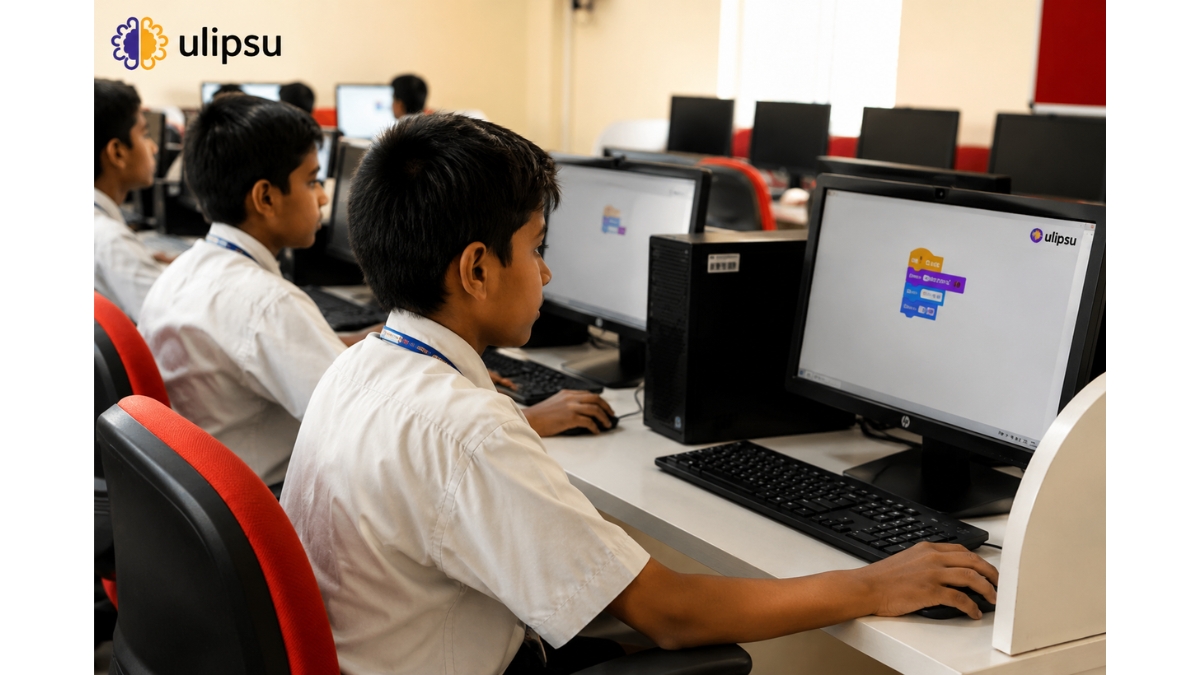
This is the problem Ulipsu platform was built to address. Running in over 500 schools across fifteen states, according to the company, Ulipsu is not a coding app or a weekend enrichment programme. It is a structured skill curriculum designed to sit inside the regular school timetable, aligned with NEP 2020 and NCF 2023, and accredited by ISTE, recognised across 127 countries, and certified by STEM.org, active in over 80 countries.
A student working through Ulipsu might spend one session on a coding module, another on financial literacy, and a third developing a project brief — all within the regular timetable. What they produce goes into a skill portfolio that travels with them. Their teacher, meanwhile, can see in real time which students are engaging and which are falling behind. From Grade 5 onwards, students sit a skill and career interest assessment built on the Holland Code framework — giving children a personalised read on their strengths and interests at an age when most Indian schools are focused entirely on examinations. The company reports that over five lakh students are currently active on Ulipsu across India.
The Equity Argument From Telangana
The most common objection to NEP’s skill education mandate from state departments managing large numbers of government schools is practical: the infrastructure does not exist. No lab, no equipment, no trained teacher. The policy, the argument goes, is designed for schools that already have resources.
In Telangana, that objection is being tested directly. Kidvento is running both its CAR (Curriculum Aligned Resources) programme and Ulipsu in government schools with limited physical infrastructure — schools where computer access at home is far from guaranteed for most students. The model does not depend on a fully built-out lab. Ms. Nagamanimala, Head Mistress of PM SHRI TGWREIS High School in Marikal — part of Telangana’s network of residential government schools for students from underserved communities — has seen the difference first-hand: “Students have not only gained theoretical knowledge but have actively engaged in projects requiring practical implementation. We have witnessed a meaningful transformation in their confidence, creativity, and problem-solving abilities.”
This is not a workaround. It is an argument that curriculum, if properly designed, can precede infrastructure — and that waiting for every government school to have a fully equipped innovation lab before beginning skill education means waiting for something that will take a generation to arrive.
Scale, Not Pilot
The risk with any education initiative in India is that it remains a pilot — impressive in a handful of schools, celebrated at conferences, but never reaching the scale at which it changes the system rather than decorates it.
Ulipsu’s footprint spans fifteen states, including Karnataka, Tamil Nadu, Telangana, Andhra Pradesh, Chhattisgarh, Maharashtra, Punjab, Uttar Pradesh, Delhi, Bihar, and Odisha. The company reports having trained over 15000 teachers as part of this work.
India has more than a million schools. The work is nowhere near done. But a model exists, it is running across diverse geographies and school types, and it is producing students who are building things, assessing their own aptitudes, and developing skills that examinations do not capture.
NEP 2020’s implementation horizon runs to 2030. But policy horizons don’t build labs or write lesson plans. The schools where something is actually changing share a common factor: an organisation that shows up, installs the infrastructure, hands a teacher a curriculum, and comes back the following term to see what happened. Whether that model reaches the scale India’s reform requires is the question the next few years will answer.
That answer is being written right now, in classrooms across fifteen states, one skill session at a time.
If you object to the content of this press release, please notify us at [email protected]. We will respond and rectify the situation within 24 hours.