Mr. Navin Rajagopalan, Director, City Lifts India Limited
Mumbai (Maharashtra) [India], June 29: India’s growing urban population and increasing vehicle ownership are intensifying one of the biggest challenges faced by modern cities i.e., parking space shortages. In densely populated urban centers where land availability is limited and real estate costs continue to rise, automated car parking systems are emerging as an innovative solution for efficient space utilization and smarter urban infrastructure management.
Traditional parking layouts consume large amounts of valuable space, especially in metro cities such as Mumbai, Delhi, Bengaluru, and Pune, where land prices are among the highest in the country. Automated parking systems offer a practical alternative by maximizing parking capacity within compact footprints. These systems use advanced mechanical and software-driven technologies to stack and retrieve vehicles automatically, enabling developers to accommodate significantly more vehicles within the same area. By optimizing land utilization, automated parking solutions are helping developers improve project feasibility while addressing growing urban mobility challenges.
The increasing adoption of automated parking systems is closely linked to India’s vertical urban development. High-rise residential towers, commercial buildings, malls, hospitals, and mixed-use developments are all seeking efficient parking infrastructure solutions that align with modern construction trends. Developers today are increasingly integrating automated parking systems at the design stage itself to improve project efficiency and enhance the overall user experience. Early integration/advance planning of automated parking technologies also enables better architectural planning, improved traffic circulation, and more efficient utilization of basement and podium spaces.
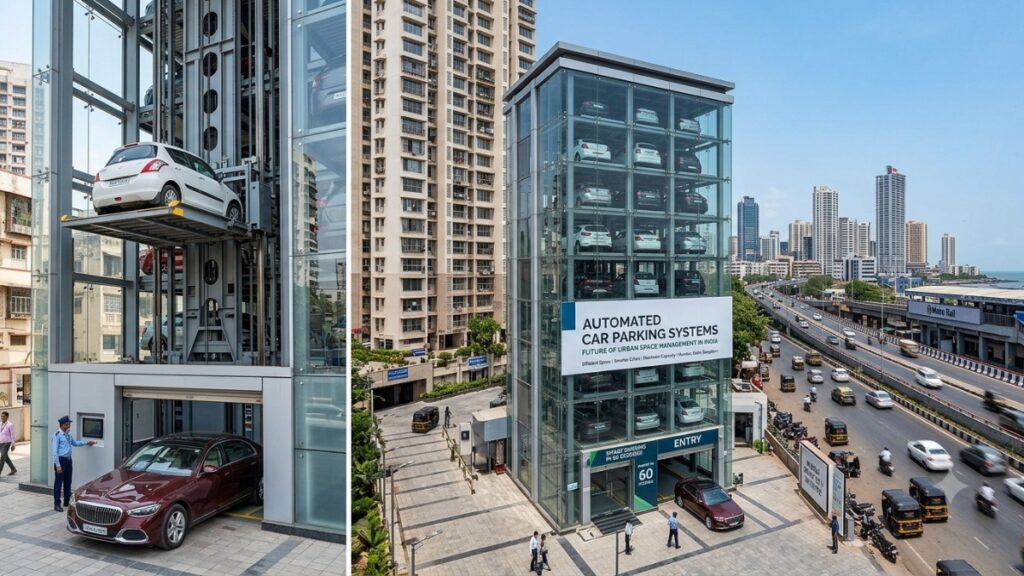
Automated Car Parking Systems
Apart from space optimization, automated parking systems also provide several operational and environmental benefits. These systems reduce vehicle movement within parking areas, helping lower fuel consumption, emissions, and traffic congestion. Since the systems minimize human intervention, they also improve safety and reduce the risk of vehicle damage or theft. In premium developments, automated parking has additionally become a lifestyle and convenience feature that enhances project positioning in the market.
The demand for integrated mobility solutions is further pushing elevator and parking solution providers to expand their offerings beyond conventional vertical transportation systems. Companies are increasingly focusing on combining elevators, escalators, and automated parking technologies to create seamless movement ecosystems within urban developments. This convergence of mobility infrastructure is helping create smarter and more connected urban environments that prioritize convenience, efficiency, and user experience.
Government focus on smart cities, infrastructure development, and sustainable urban planning is also expected to accelerate adoption of automated parking technologies in the coming years. As Indian cities continue to grow vertically and vehicular density rises further, automated parking systems are likely to become a critical component of future-ready urban infrastructure.